Quick Summary
You have finally found the tiles you want for your kitchen and are ready to place your order. Just before checkout, the salesperson asks, “Do you want rectified or non-rectified tiles?” The question catches you off guard because both options look almost identical in colour, size and finish. Unless you know what those terms mean, it is difficult to tell which one is the better choice.
This guide explains what rectified and non-rectified tiles are, how they differ, and how to choose the right option for your kitchen. For help selecting and installing the right tiles, our kitchen tiling solutions provide expert advice and quality finishes for London homes.
The Difference Is in the Edge, Not the Tile
Rectified tiles are ordinary porcelain or ceramic tiles that have been through one extra step at the factory. That step happens after firing, and it changes the edge — not the body, the colour, or the surface.
Get that one detail right and everything else follows from it: how tight the grout lines can run, how forgiving the substrate needs to be, and how the finished floor or wall actually reads from across the room.
What is a rectified tile?
Every tile is pressed and then fired in a kiln, and firing makes the clay body shrink. That shrinkage is never perfectly even across a production run, so tiles from the same batch can vary slightly in their finished dimensions.
Rectification deals with that mechanically. Once the tiles have cooled, a diamond saw or grinding wheel trims all four edges back to one exact dimension, leaving a sharp, square profile with almost no size difference from one tile to the next.
That’s also why rectified tiles are sometimes labelled calibrated. Different word, same idea: dimensional accuracy tight enough that the tiles behave as though they’re identical.
What Are Non-Rectified Tile Edges, and Why Do They Look Different?
A non-rectified tile leaves the kiln as it comes, with the edge shaped by the press rather than by a blade. The profile is slightly softer, often with a small cushioned curve where the face meets the side.
That softness is deliberate. A pressed edge is far more forgiving of the natural variation between tiles, because a wider joint absorbs any small difference in length without it becoming visible.
Non-rectified is not a lower grade of tile. Plenty of high-quality ranges are produced this way, particularly traditional formats where the gently rounded edge is part of the character.
How the edge changes the finished look
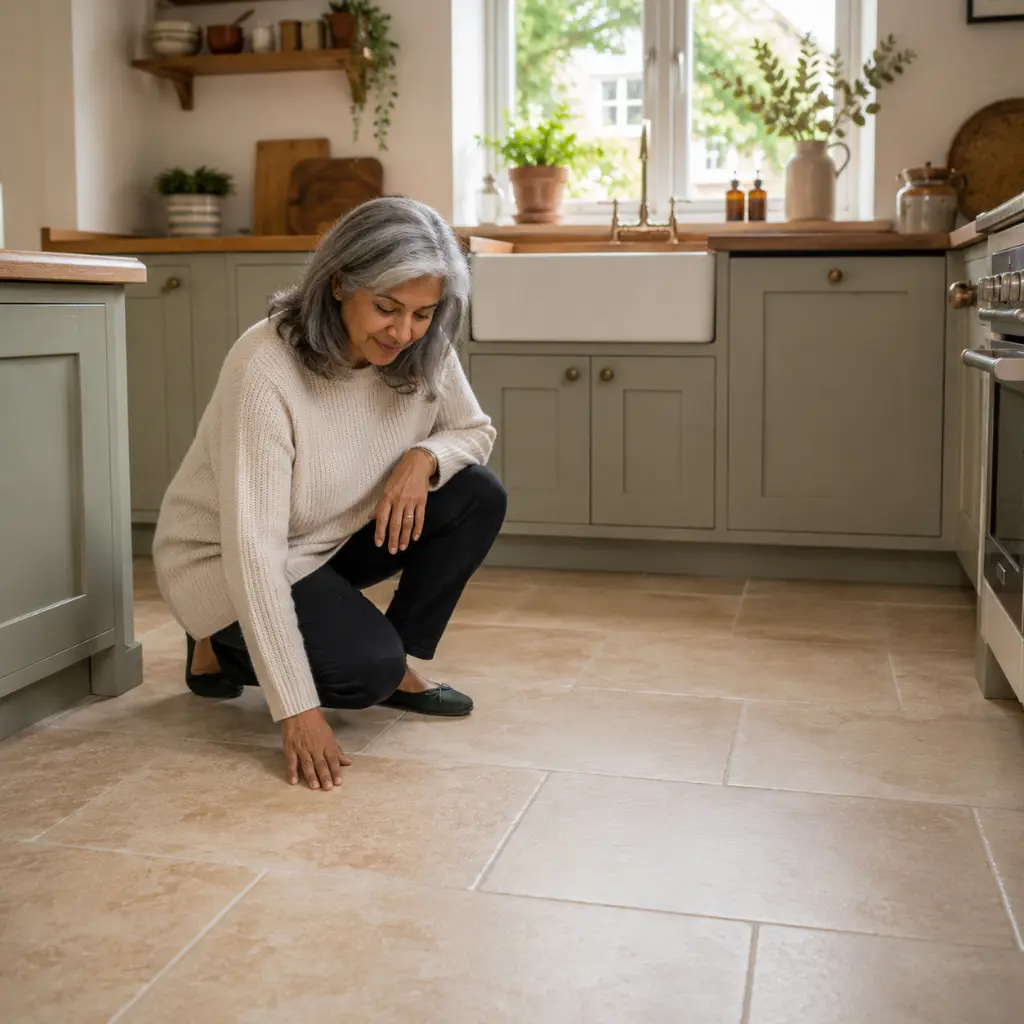
The most visible difference is joint width. Rectified tiles can usually be laid with joints of around 2mm, while a pressed edge generally wants 3mm or more so the variation has somewhere to go.
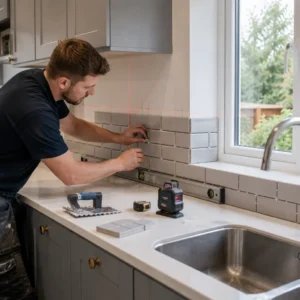
That changes how the surface reads. Fine joints let a floor read as one continuous plane, particularly with large format tiles, while a wider joint outlines each tile and gives the surface a defined grid. This becomes especially visible in tile layout around a window , where every cut either side of the opening has to agree, and a tighter joint leaves less room to disguise a mismatch.
The cushioned edge adds a second, subtler effect. It catches light along every tile, which softens the whole wall or floor and suits period and country style kitchens.
What Each Edge Asks of the Installation
Sharp edges are honest, for better or worse. With nothing to soften the meeting point between two tiles, any difference in height gets caught by the light immediately, so a rectified floor needs a genuinely flat base underneath it.
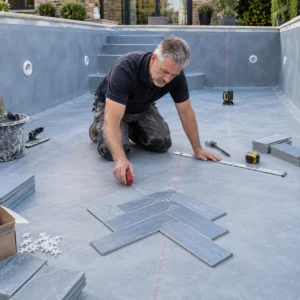
In a London kitchen, that means checking the substrate with a long straight edge first and correcting anything beyond a couple of millimetres with a levelling compound before a single tile goes down. Leveling clips stop being optional too — they hold neighbouring tiles in the same plane while the adhesive cures, then snap off at the base once it has set.
A pressed edge is more forgiving of an imperfect background, which is one reason it still suits older properties where walls and floors have shifted over the years. Either way, full adhesive coverage matters — a void under the tile leaves that edge unsupported, sharp or soft.
For a Modern Kitchen: Which Edge Actually Wins?
For most modern kitchens, rectified tiles are the stronger choice. Installed properly, they give a cleaner appearance, tighter grout lines and a more seamless finish than a pressed edge can manage.
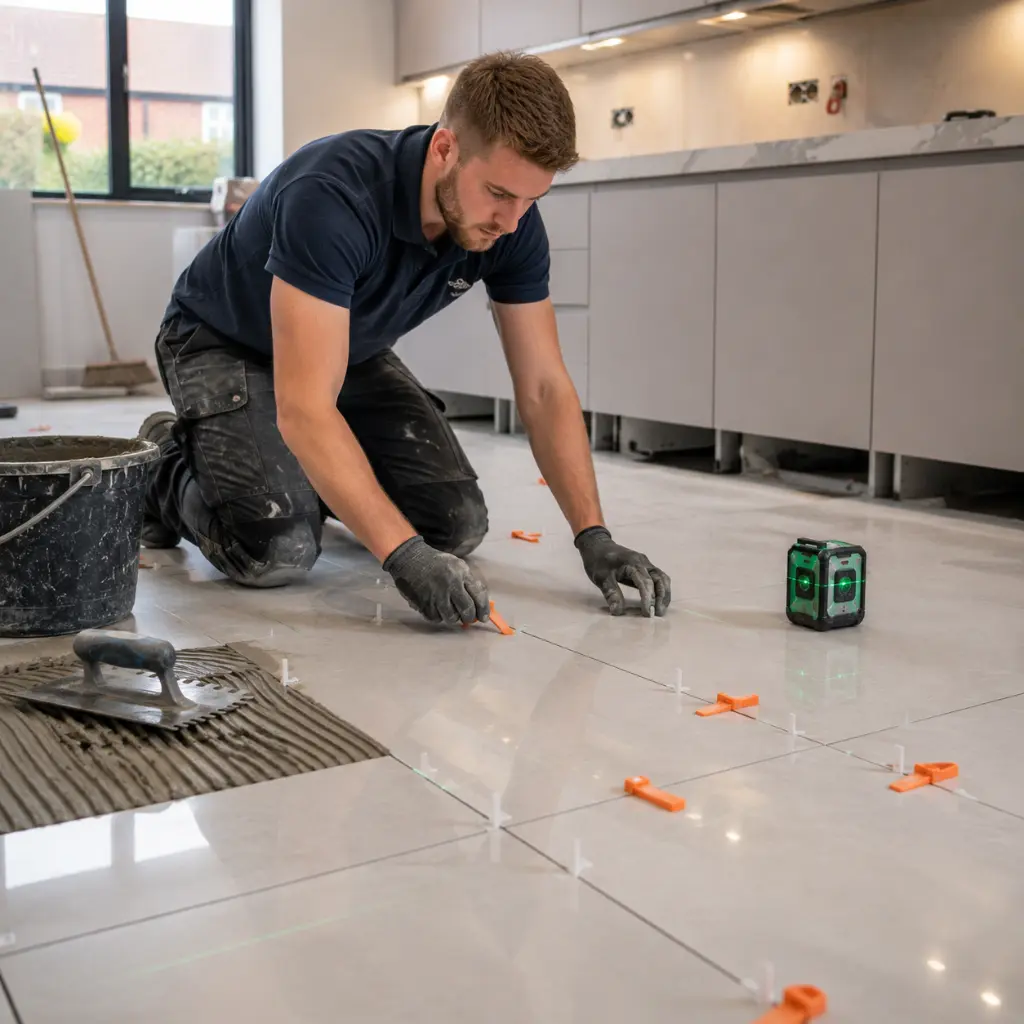
Rectified Tiles for Kitchen Floor
Large format porcelain with a machine-cut edge is a strong choice for an open plan kitchen, because fewer joints across the span means a calmer floor and a simpler surface to keep clean. That same edge also cuts cleanly into the tile skirting strips along the base of the wall, keeping the line as straight as the floor it matches.
Splashbacks and Kitchen Walls
Behind a worktop, the choice follows the cabinetry. A handleless slab kitchen sits comfortably with fine joints and a flat, uninterrupted tiled surface. In contrast, a shaker or in-frame kitchen is usually happier with a pressed edge and a slightly wider joint.
Mixing Rectified and Non-Rectified Tiles in the Same Kitchen
Using a rectified floor with a pressed edge splashback is completely workable, since the two surfaces are read separately by the eye. Mixing both edge types within the same plane is where the joint widths stop agreeing with each other.
Checks worth making before you order
Look for the word rectified on the box, or rettificato on Italian and Spanish ranges. If the label is silent, assume the tile is pressed edge and plan the joints accordingly.
Check the shade and calibre codes on each box while you are there. Ordering the whole area from one production batch keeps the tones and the sizing consistent across the room.
It is also worth asking the supplier what minimum joint width the manufacturer recommends for that specific tile. Some rectified ranges still call for 3mm, particularly in longer formats, and that advice is written for a reason.
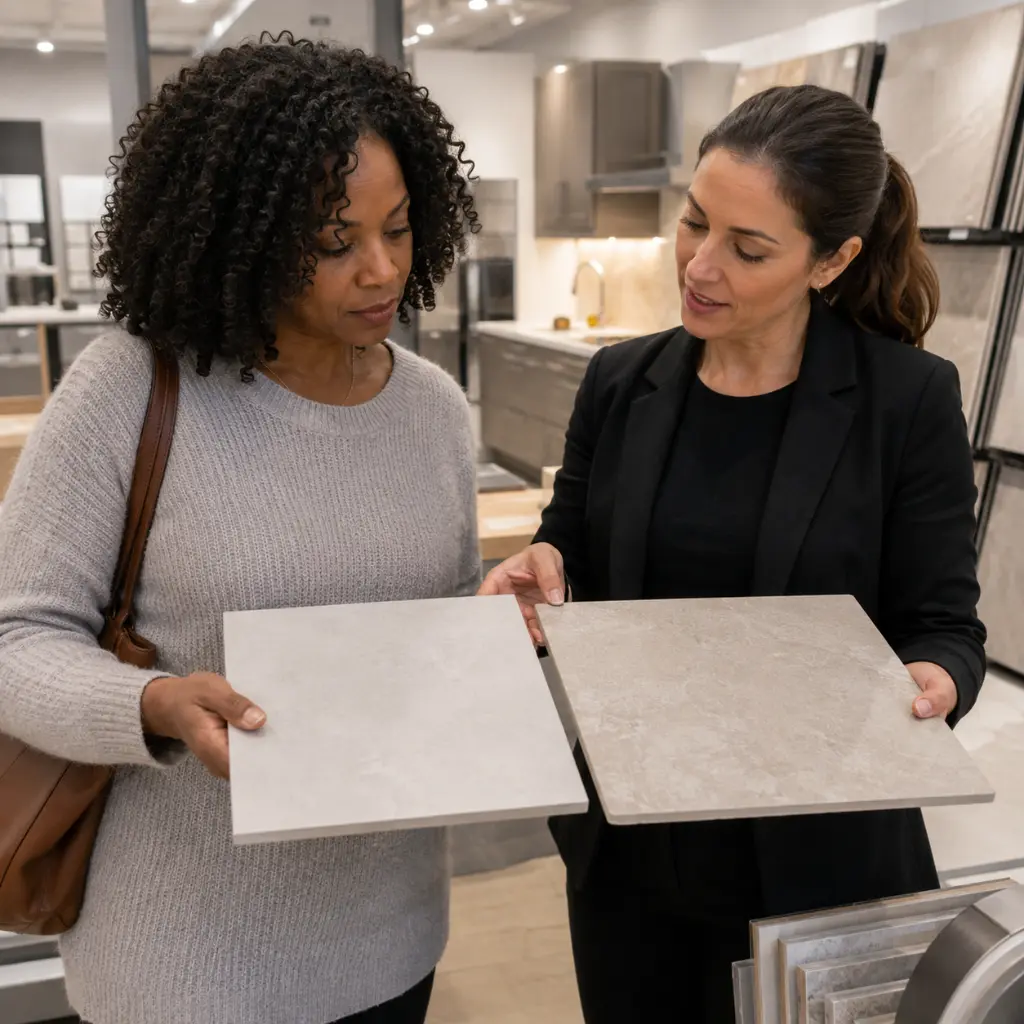
Finally, hold two tiles together face to face and look along them. This tells you more in a few seconds than any product description will.
Conclusion:
Choosing the right tile edge plays an important role in achieving the finish you want for your kitchen. With professional advice and correct installation, your tiles can provide a durable and attractive result for years.
At Abel Tiler London, we help homeowners choose and install the right tiles for their kitchen projects, providing professional tiling solutions with a focus on quality finishes and long-lasting results.